


Page 115 - AERB Annual Report 2020
P. 115
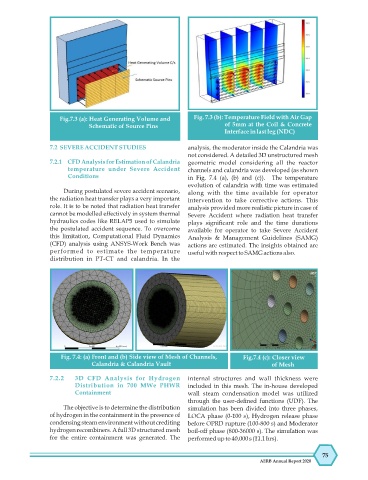
Fig.7.3 (a): Heat Generating Volume and Fig. 7.3 (b): Temperature Field with Air Gap
Schematic of Source Pins of 5mm at the Coil & Concrete
Interface in last leg (NDC)
7.2 SEVERE ACCIDENT STUDIES analysis, the moderator inside the Calandria was
not considered. A detailed 3D unstructured mesh
7.2.1 CFD Analysis for Estimation of Calandria geometric model considering all the reactor
temperature under Severe Accident channels and calandria was developed (as shown
Conditions in Fig. 7.4 (a), (b) and (c)). The temperature
evolution of calandria with time was estimated
During postulated severe accident scenario, along with the time available for operator
the radiation heat transfer plays a very important intervention to take corrective actions. This
role. It is to be noted that radiation heat transfer analysis provided more realistic picture in case of
cannot be modelled effectively in system thermal Severe Accident where radiation heat transfer
hydraulics codes like RELAP5 used to simulate plays signicant role and the time durations
the postulated accident sequence. To overcome available for operator to take Severe Accident
this limitation, Computational Fluid Dynamics Analysis & Management Guidelines (SAMG)
(CFD) analysis using ANSYS-Work Bench was actions are estimated. The insights obtained are
performed to estimate the temperature useful with respect to SAMG actions also.
distribution in PT-CT and calandria. In the
Fig. 7.4: (a) Front and (b) Side view of Mesh of Channels, Fig.7.4 (c): Closer view
Calandria & Calandria Vault of Mesh
7.2.2 3D CFD Analysis for Hydrogen internal structures and wall thickness were
Distribution in 700 MWe PHWR included in this mesh. The in-house developed
Containment wall steam condensation model was utilized
through the user-dened functions (UDF). The
The objective is to determine the distribution simulation has been divided into three phases,
of hydrogen in the containment in the presence of LOCA phase (0-100 s), Hydrogen release phase
condensing steam environment without crediting before OPRD rupture (100-800 s) and Moderator
hydrogen recombiners. A full 3D structured mesh boil-off phase (800-36000 s). The simulation was
for the entire containment was generated. The performed up to 40,000 s (11.1 hrs).
75
AERB Annual Report 2020

